
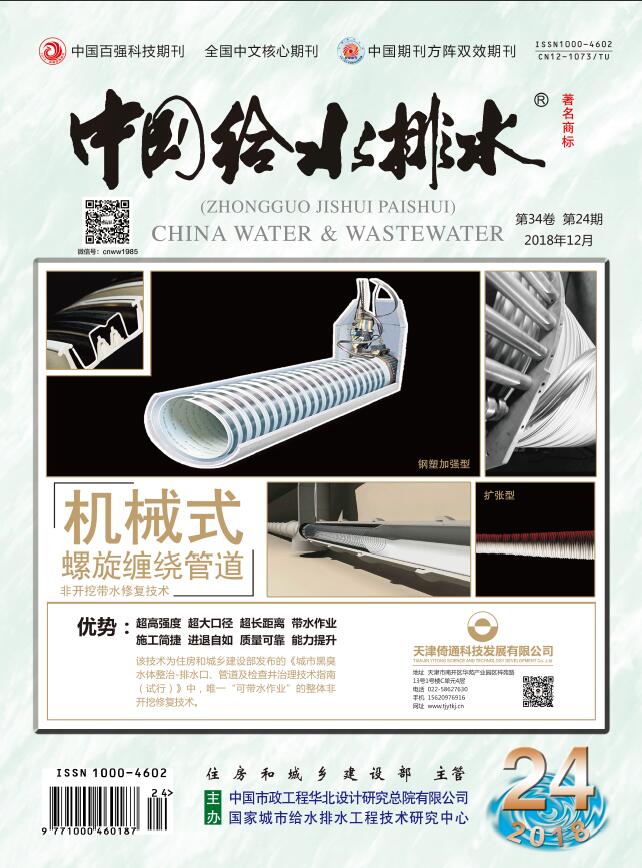
QUANChen-yan,GUOYuan,ZHANGZhao-he,et al.Efficiency and Mechanism of Ozone-Biological Activated Carbon Advanced Treatment Process for Low-turbidity and Micro-polluted Raw Water in Northern China[J].China Water & Wastewater,2025,41(23):55-63.
Efficiency and Mechanism of Ozone-Biological Activated Carbon Advanced Treatment Process for Low-turbidity and Micro-polluted Raw Water in Northern China
China Water & Wastewater[ISSN:1000-4062/CN:12-1073/TU]
volume:
第41卷
Number:
第23期
Page:
55-63
Column:
Date of publication:
2025-12-01
- Keywords:
- drinking water treatment; ozone-biological activated carbon (O3-BAC); low-turbidity raw water; functional bacteria; biological risk
- Abstract:
- The performance of the two treatment systems of a water treatment plant in northern China operating both conventional treatment and ozone-biological activated carbon (O3-BAC) processes in terms of water quality improvement and pollutants removal was evaluated under consistent source water conditions characterized by winter low-temperature, prolonged low-turbidity, and rganic micro-pollutants, so as to investigate the purification efficiency and underlying mechanisms of the O3-BAC advanced treatment process in treating low-turbidity and micro-polluted raw water in northern China. Additionally, the bacterial community composition, its dynamic variations, and associated biological risks were systematically analyzed. It showed that the O3-BAC advanced treatment process was well suited for treating low-turbidity, micro-polluted raw water in northern China; however, its performance was significantly influenced by seasonal variations. The integration of O3-BAC with conventional treatment processes enabled the establishment of multi-barrier systems for enhanced removal of pollutants. Notably, biofilms developed on carbon and sand packing media contributed significantly to the degradation of organic micro-pollutants, with key microbial genera including Saprospiraceae and Blastocatella playing a pivotal role.
Last Update:
2025-12-01